
Jump to section
- Is a GEO certification worth it?
- What does a GEO certification prove?
- What does the 2026 hiring data actually show?
- What do employers actually look for?
- How do certificates compare with portfolios?
- Which GEO and AEO courses are worth considering?
- What is the strongest alternative to certification?
- Does certification have any measurable employment value?
- When is a GEO certification worth paying for?
- How should you decide whether to get certified?
- FAQ
- Sources
Summarize with ChatGPT Claude Perplexity
TL;DR
- A GEO certification can document structured learning, but current evidence does not establish it as a substitute for a portfolio or as a proven employment investment.[9][10]
- Omniscient found AI-search requirements in 62.2% of 690 sampled SEO postings, while Search for Hire found broad AI-related terms in 54.9% of 1,175 listings; neither figure measures demand for a GEO credential.[7][6]
- Employers such as Career Certified and Genius PR ask candidates to explain tests, measurements, case studies, live work and references.[10]
- Free HubSpot and Semrush courses can establish a learning baseline, but their value depends on what the learner can apply and show.[5][12]
- For most marketers, the strongest path is to learn the fundamentals, build a documented GEO project and add certification only when it fills a clear skills or signalling gap.[1]
Is a GEO certification worth it?
A GEO certification can be worth it when it gives a marketer structured training, a practical project and a credible way to document new skills. It is not yet established as a substitute for hands-on experience, a portfolio or measurable results: the available hiring evidence shows demand for AI-search skills, not a proven employment or salary return from a GEO badge.[1]
What does a GEO certification prove?
Generative engine optimization, or GEO, covers efforts to improve how brands and content appear in answers produced by generative search systems. Closely related terms include answer engine optimization (AEO), AI search optimization and LLM optimization.
A certificate usually proves that someone completed a defined course or passed its assessment. It does not automatically prove that the person can diagnose an AI-search problem, design a suitable test, implement changes, measure visibility or explain commercial results.
That distinction matters because the market does not use “GEO certification” as a standardized professional qualification. Official programs vary considerably in scope:
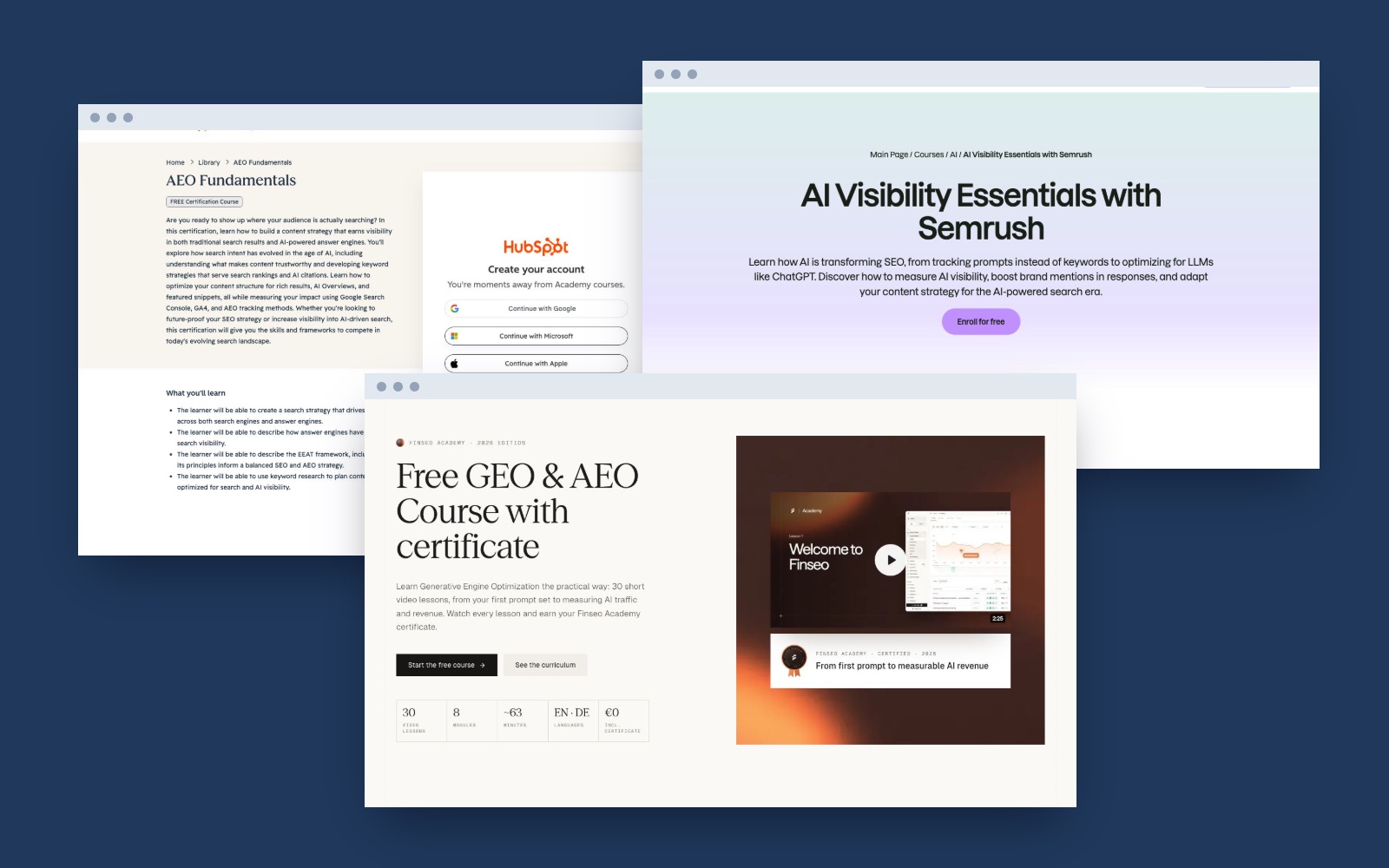
- HubSpot’s AEO Fundamentals course covers search strategy, AI citations, content optimization and measurement.[2][3]
- Semrush’s AI Search Operating System course focuses on auditing visibility, defining key performance indicators and building an action plan.[4]
- Muck Rack’s GEO course approaches the subject through brand visibility, prompt testing, earned media and PR measurement.[5]
These are different learning paths rather than equivalent examinations. A certificate from one provider may show familiarity with that provider’s curriculum, while an employer may be looking for technical SEO, content operations, analytics, public relations or broader marketing experience.
The most useful question is therefore not “Is this badge valuable?” but:
What can this course teach, assess and help you demonstrate that you could not already show?
A certificate is more useful when it includes a meaningful assessment, requires applied work and produces an artifact that can be inspected. A completion badge with no practical assignment may still document learning, but it provides weaker evidence of execution.
What does the 2026 hiring data actually show?
The strongest current evidence supports demand for AI-search skills, not demand for a specific credential.
Omniscient’s September 2026 study examined 690 unique North American SEO job postings and found that 62.2% included AI-search requirements. GEO and AEO were tied as the most commonly used AI-search terminology in that sample.[6] The study analyzed 54,257 LinkedIn jobs posted on or before 21 August 2026 before filtering and deduplicating the results, so it represents a 2026 sample rather than a count of jobs newly created during the year.[6]
A separate Search for Hire analysis found broad AI-related language in 54.9% of 1,175 full-time US SEO listings posted between April 2025 and March 2026.[7] Its definition included AI, LLM, AEO, GEO, automation and workflows, so the figure should not be interpreted as GEO- or AEO-only demand.[7]
| Finding | What it measures | What it does not prove |
|---|---|---|
| 62.2% of 690 SEO postings included AI-search requirements | AI-search skills language in one North American SEO sample[6] | That employers require or prefer a GEO certificate |
| GEO and AEO were tied as leading terms in the Omniscient sample | Use of emerging terminology in job descriptions[6][8] | That the terms represent standardized qualifications |
| 54.9% of 1,175 listings mentioned broad AI-related keywords | AI-related hiring language under a broad definition[7] | A GEO/AEO-only hiring rate or certificate premium |
| 11% of the Search for Hire listings used AI in the job title | Visibility of AI language in titles[6][7] | A causal advantage for certified applicants |
The evidence supports a careful conclusion: learning AI-search methods may help marketers align with changing role requirements. It does not establish that buying a particular course leads to more interviews, higher pay or faster employment.
Omniscient also advises treating its research waves as point-in-time comparisons rather than a continuous trend line.[6] The percentages should therefore be used as context, not as a precise forecast of the entire GEO job market.
What do employers actually look for?
The clearest employer evidence emphasizes applied work.
A September 2026 SEO Manager, AI Search & GEO listing from Career Certified asks for at least five years of hands-on SEO experience, including technical SEO, content optimization, keyword research and performance analysis.[9] Applicants must also explain what they tested, measured and learned from GEO, AEO, LLM optimization or AI-search visibility work.[9]
Genius PR’s GEO/AEO Specialist listing asks candidates for hands-on client experience, a repeatable methodology, platform knowledge, case studies, live work samples and contactable references.[10] Its evidence requirements include named or anonymized case studies, exact prompts and platforms, dated before-and-after evidence and live URLs showing the work.[10]
Airbnb’s Senior Growth Marketing Lead role sets a more senior bar: at least ten years of SEO experience, including two years in senior or leadership work, plus SQL, measurement and cross-functional implementation experience.[11] The reviewed qualifications do not name a GEO certification.[12][13]
These advertisements are examples, not a representative survey of all employers. Their value is that they show what evidence can look like in an actual application:
- A clearly defined problem.
- The prompts, platforms or markets tested.
- The intervention made.
- A dated before-and-after comparison.
- The measurement method.
- The limitations of the test.
- The business or audience context.
- A live page, case study or work sample.
- A clear explanation of what changed and what was learned.
A certificate can sit beside this evidence. It rarely replaces it.
How do certificates compare with portfolios?
A certificate communicates structured learning. A portfolio demonstrates applied judgment.
That difference is especially important in GEO because AI-search visibility can vary by prompt, engine, location, language and time. A candidate who can explain experimental design, source selection, content changes and measurement gives an employer more information than a badge alone.
TorontoSEO describes certifications as a weak signal that may provide context or act as an occasional tiebreaker, while prioritizing case studies, portfolios and results during resume review.[1] The article reflects one agency’s hiring perspective rather than a representative employer survey.[14]
Ahrefs reported that 86% of 15 surveyed SEO hiring managers considered certifications unimportant, but the sample is small and the survey concerns SEO rather than specifically GEO hiring in 2026.[12] It should be treated as older, limited context rather than a definitive market statistic.
The practical comparison is straightforward:
| Route | What it can demonstrate | Main limitation |
|---|---|---|
| GEO or AEO certificate | Completion of a defined curriculum or assessment pathway[12] | May not show client delivery, judgment or measurable outcomes |
| Self-directed project | Ability to formulate a question, test changes and document results | Findings may be limited by small samples or uncontrolled conditions |
| Client case study | Applied work in a real business context | Confidentiality may restrict what can be published |
| Portfolio of audits and experiments | Breadth of analysis, communication and implementation | Requires time and careful documentation |
| Formal accreditation | Potentially standardized competence if independently assessed | The stronger accreditation model described in current commentary is proposed, not established |
A portfolio does not need to claim dramatic visibility gains. A well-designed small study can be persuasive if it states the prompt set, engines, timeframe, intervention, measurement and limitations.
The academic GEO paper by Aggarwal and colleagues offers a useful example of the kind of testable work learners should understand. Its experiments compare optimization methods with unmodified sources and report visibility improvements of up to 40% under the study’s conditions.[15] Adding citations, quotations and statistics produced a 30–40% relative improvement on its Position-Adjusted Word Count metric, while keyword stuffing performed poorly against the baseline.[15] Finseo’s own review of 2026 replications found that the famous 40% GEO lift is rank-dependent: the same edit moved a rank-5 page +115% and a rank-1 page −30%.
Those results concern experimental visibility, not employment or certification outcomes. They demonstrate why employers may value the ability to test and interpret evidence over familiarity with terminology alone.
Which GEO and AEO courses are worth considering?
The best course depends on the gap it fills, not on the existence of a badge.
| Course | Published price | Published duration | Assessment disclosed | Best fit |
|---|---|---|---|---|
| HubSpot AEO Fundamentals | Free[2][3] | 2 hours 20 minutes; 7 lessons and 19 videos[3] | Assessment format and practical requirements not published on the reviewed page[12] | Marketers seeking a product-agnostic AEO introduction |
| Semrush AI Search Operating System | Free enrollment; certificate offered[4] | Individual lesson durations published; total time not published[16] | The course identifies an exam; pass mark and independent practical assessment are not published[1][4] | SEO practitioners wanting an operating and measurement framework |
| Muck Rack Fundamentals of GEO | Price not published on the reviewed page[12] | Described as about one hour; curriculum lists 1.5 hours[5] | Module quizzes and an exam are required; separate practical assessment not published[5][17] | PR and communications professionals connecting GEO with earned media |
HubSpot explicitly distinguishes its free, product-agnostic AEO Fundamentals course from a separate certification focused on implementing AEO with HubSpot.[2] That distinction is useful for buyers: a platform-specific credential may be relevant when an employer uses that platform, while a general course may transfer more easily across employers.
Muck Rack publishes a completion route involving lessons, module quizzes and an exam.[5][12] That establishes an assessment pathway, but the provider’s suggestion that the certificate can signal fluency to clients or employers is positioning from the course provider, not an independently measured hiring result.[1]
Semrush provides a free AI Search Operating System course and offers certification after the course pathway.[4] Its value depends on whether the learner turns the operating concepts into audits, experiments, reporting templates or client work.
Before enrolling, check five details:
- Does the course teach the work you need, such as prompt research, citation analysis, content optimization, analytics or technical implementation?
- Is there an exam, graded project, practical exercise or only video completion?
- Can you publish or privately show the work produced during the course?
- Is the curriculum product-agnostic or tied to one vendor’s platform?
- Does the target employer recognize the provider, or will you need to explain the credential?
Course pages do not consistently publish expiry rules, pass marks or practical requirements.[1][12] Treat undisclosed information as unknown rather than assuming that certificates are permanent, proctored or independently assessed.
What is the strongest alternative to certification?
For most marketers, the strongest alternative is a small, well-documented portfolio project.
A useful project could compare how several AI systems answer a defined group of commercial questions before and after a content or digital PR intervention. The project should avoid implying that a single set of observations proves universal visibility improvement.
A practical GEO portfolio checklist
- Choose a real or realistic brand, audience and market.
- Define 10–30 prompts across informational, commercial and comparison intent.
- Record the engines, dates, locations and language used.
- Capture brand mentions, cited domains, competitors and answer position.
- Identify recurring source types and content gaps.
- Make a limited intervention, such as revising an explainer, adding evidence or improving entity clarity.
- Repeat the same observations after a defined period.
- Report changes without claiming causation that the design cannot support.
- Explain confounding factors, including model updates and changing search results.
- Present the findings in a concise case study with screenshots, tables and recommendations.
This approach creates evidence for the questions Career Certified and Genius PR ask: What did you test? What did you measure? What did you learn?
The project can also show communication skills. A hiring manager may care less about whether the candidate calls the activity GEO or AEO than whether the candidate can turn uncertain observations into a defensible recommendation.
What should a one-page GEO case study include?
Include the business context, research question, prompt set, engines and dates, baseline observations, intervention, follow-up observations, limitations and recommended next action. Add a short section explaining what the evidence cannot establish. If client information is confidential, anonymize the brand and remove sensitive figures while preserving the method and decision logic.
Does certification have any measurable employment value?
There is some evidence that making an already-earned credential visible can affect employment, but it does not establish the return from buying a GEO certification.
A randomized study by Susan Athey and Emil Palikot involved more than 800,000 online certificate earners in developing countries who lacked college degrees. The intervention encouraged approximately 40,000 learners to share existing credentials on LinkedIn, and the revised paper reports a 6% increase in new employment, equivalent to 1.0 percentage point.[18]
Stanford’s summary reports the same 6% increase.[19][9] The study tested the visibility of credentials that participants had already earned; it did not compare a GEO course with a portfolio, measure a GEO-specific salary premium or establish that a particular certificate causes better hiring outcomes.[1]
This is useful counterevidence to the claim that certificates never matter. It is not evidence that a GEO certification gets marketers hired.
The distinction is between:
- Learning value: what the course teaches.
- Signalling value: what the credential communicates.
- Evidence value: what the learner can show.
- Market value: whether employers recognize it.
- Financial return: whether it changes employment, pay or revenue.
The cited research does not publish a GEO-certification interview rate, salary premium, placement rate or payback period. Those outcomes should be treated as unknown, not as zero.
When is a GEO certification worth paying for?
A paid certification is more defensible when at least one of these conditions applies:
- The employer or client specifically requests it.
- The course includes substantial practical work and feedback.
- The provider is recognized by the target market.
- The curriculum fills a clear skills gap.
- The certificate is bundled with access to tools, mentoring or a professional network.
- You will use the course project as the first piece of a broader portfolio.
- The price is small relative to the time and alternative learning options.
A free course is often enough for a baseline. HubSpot and Semrush both provide free learning options, although their scope and assessment formats differ.[12]
A paid course is less attractive when it mainly repackages public concepts, offers no inspectable assessment and promises employment outcomes without evidence. It is also a weak investment if the target role expects years of SEO, analytics, implementation or client experience that a short certificate cannot provide.
Nick LeRoy’s proposed accreditation model illustrates what a stronger credential might look like: 40% proctored knowledge testing and 60% live sandbox assessment, with practical diagnosis, prioritization and executive communication.[17] He also proposes annual updates and full recertification every three years.[17] This is a proposal, not an established GEO qualification or proof that current courses deliver those conditions.
How should you decide whether to get certified?
Use this decision rule:
- If you are new to AI search, start with a free course and build one documented project.
- If you already work in SEO, content or PR, prioritize a portfolio case study tied to a real business question.
- If a target employer names a specific credential, obtain it if the cost and effort are reasonable.
- If you need a platform-specific skill, choose the course associated with that platform.
- If you need external credibility, verify whether the target employers recognize the provider.
- If you are considering a costly course, ask for its assessment method, practical requirements, expiry policy and graduate outcomes.
- If the course cannot help you produce inspectable work, compare it with a free curriculum plus a self-directed experiment.
The defensible verdict is that a GEO certification can document structured learning, but it is not established as a substitute for a portfolio or as a proven employment investment. For most marketers, the best sequence is learn, test, document and then certify if the credential adds a specific signalling benefit.
Frequently asked questions
Is a GEO certification worth it in 2026?
It can be worthwhile for structured learning, a defined assessment or a specific employer requirement. Current research shows frequent AI-search skills language in sampled SEO postings, but it does not establish a hiring or salary return from GEO certification.[7]
Do employers require a GEO or AEO certification?
The reviewed Career Certified, Genius PR and Airbnb listings describe practical experience, testing, measurement, case studies or cross-functional delivery without naming a specific GEO certification.[1][10] These examples do not represent every employer, so they cannot prove that credentials are never requested.
Is an AEO certification different from a GEO certification?
The terms overlap, but courses may emphasize different applications. HubSpot’s AEO Fundamentals course covers AI citations, content optimization and measurement, while Semrush emphasizes AI-search auditing, KPIs and action planning.[3]
Are free GEO courses good enough?
A free course can provide a useful baseline, particularly when it has a clear curriculum and assessment pathway. HubSpot and Semrush both offer free learning options, but learners should supplement them with a project that demonstrates testing and measurement.[1]
What should I put in a GEO portfolio?
Include the research question, prompt set, engines, dates, baseline results, intervention, follow-up observations, limitations and recommendations. Genius PR’s requirements provide a practical model by requesting case studies, exact prompts and platforms, dated evidence, live work and references.[10]
Can a GEO certificate increase salary?
The cited evidence does not publish a GEO-certification salary premium or causal pay increase. A randomized study found a 6% increase in new employment when existing online credentials were made more visible, but it did not test GEO certificates or salary outcomes.[18]
Sources
- Are SEO Certifications Worth It in 2026? A Hiring Manager's View · torontoseo.com
- HubSpot Academy | Become an Expert in AI Search · offers.hubspot.com
- AEO Fundamentals · academy.hubspot.com
- Free AI Search Operating System Course - Semrush Academy · semrush.com
- Fundamentals of Generative Engine Optimization (GEO) · academy.muckrack.com
- Having AI Search Skills is Becoming the New Norm in SEO Roles [Research] · beomniscient.com
- SEO Hiring Trends 2026 | Analysing 1,175 SEO Jobs & Salaries · searchforhire.com
- How are SEO roles changing with AI search? - Omniscient Digital · beomniscient.com
- SEO Manager, AI Search & GEO | Dayforce Jobs · jobs.dayforcehcm.com
- GEO / AEO Specialist | Genius PR Careers · geniuspr.com
- Senior Growth Marketing Lead (SEO, AEO, GEO) - Careers at Airbnb · careers.airbnb.com
- 5 Best SEO Certifications: Free & Paid · ahrefs.com
- Is AI Killing SEO Jobs? What Hiring Teams Want | Previsible · previsible.com
- The State of SEO Jobs in 2026: What the Data Says | SERPs · serps.io
- GEO: Generative Engine Optimization · arxiv.org
- Job Application for AEO & GEO Lead at Spring Health · job-boards.greenhouse.io
- The trust crisis: SEO desperately needs accreditation · searchengineland.com
- [2405.00247] The Value of Non-Traditional Credentials in the Labor Market · arxiv.org
- The Value of Non-traditional Credentials in the Labor Market | Stanford Graduate School of Business · gsb.stanford.edu