Jump to section
Summarize with ChatGPT Claude Perplexity
TL;DR
- Published introductory course time can be approximately 2 hours 29 minutes using Finseo and Ahrefs, but that subtotal is not a proficiency guarantee.[4][18]
- HubSpot publishes AEO Fundamentals at 2 hours 20 minutes and Implementing AEO With HubSpot at 2 hours 58 minutes.[2]
- GEO reading time is not officially published for the 12-page research paper or the core Google and OpenAI documentation, so reading should remain outside course-hour totals.[4]
- A responsible learner should use a stable prompt set, daily collection, weekly interpretation, and a logged content change because generated answers and sources can vary substantially.[4]
- A practical study budget is approximately 2 hours 29 minutes for one week, 5 hours 29 minutes for one month, or 17 hours 27 minutes for one quarter, with reading and hands-on measurement added separately.[4][20]
Published GEO and AEO course material can be completed in a few hours, but working competence takes longer because it also requires reading documentation, creating a stable prompt set, making a controlled content change, and observing repeated answers over several weeks. A realistic learner should separate course time, practice time, and measurement time rather than treating a certificate’s runtime as a time-to-results promise.
What does it mean to learn GEO?
Generative engine optimization, or GEO, is the practice of improving how generative search systems discover, retrieve, cite, and describe a brand or webpage. The original GEO research evaluates techniques including adding citations, quotations, and statistics, but its experimental improvements do not establish a universal timeline for improving a newly edited webpage in live search.[1][2]
For a marketer or SEO, “learning GEO” should mean being able to:
- Explain how generative search differs from conventional search.
- Build a repeatable set of branded and unbranded prompts.
- Record answer text, cited sources, engine, location, date, and settings.
- Distinguish brand mentions, citations, position, sentiment, and traffic.
- Identify content gaps suggested by repeated answers and sources.
- Make one documented content change without changing the measurement setup.
- Interpret repeated observations without treating one answer as a baseline.
That final skill matters because generative answers vary. Research found that retrieved-link overlap between conventional search and Google AI Overviews was substantially different, while categorical answers could change after five minutes or 24 hours.[3] Separate research found that ChatGPT and Google reproduced the same brand list fewer than one time in 100, with identical ordered lists occurring about one time in 1,000.[4]
A short course can teach the vocabulary and workflow. It cannot, by itself, prove that a page has become more visible, more frequently cited, or more commercially effective.
How long are the main GEO and AEO courses?
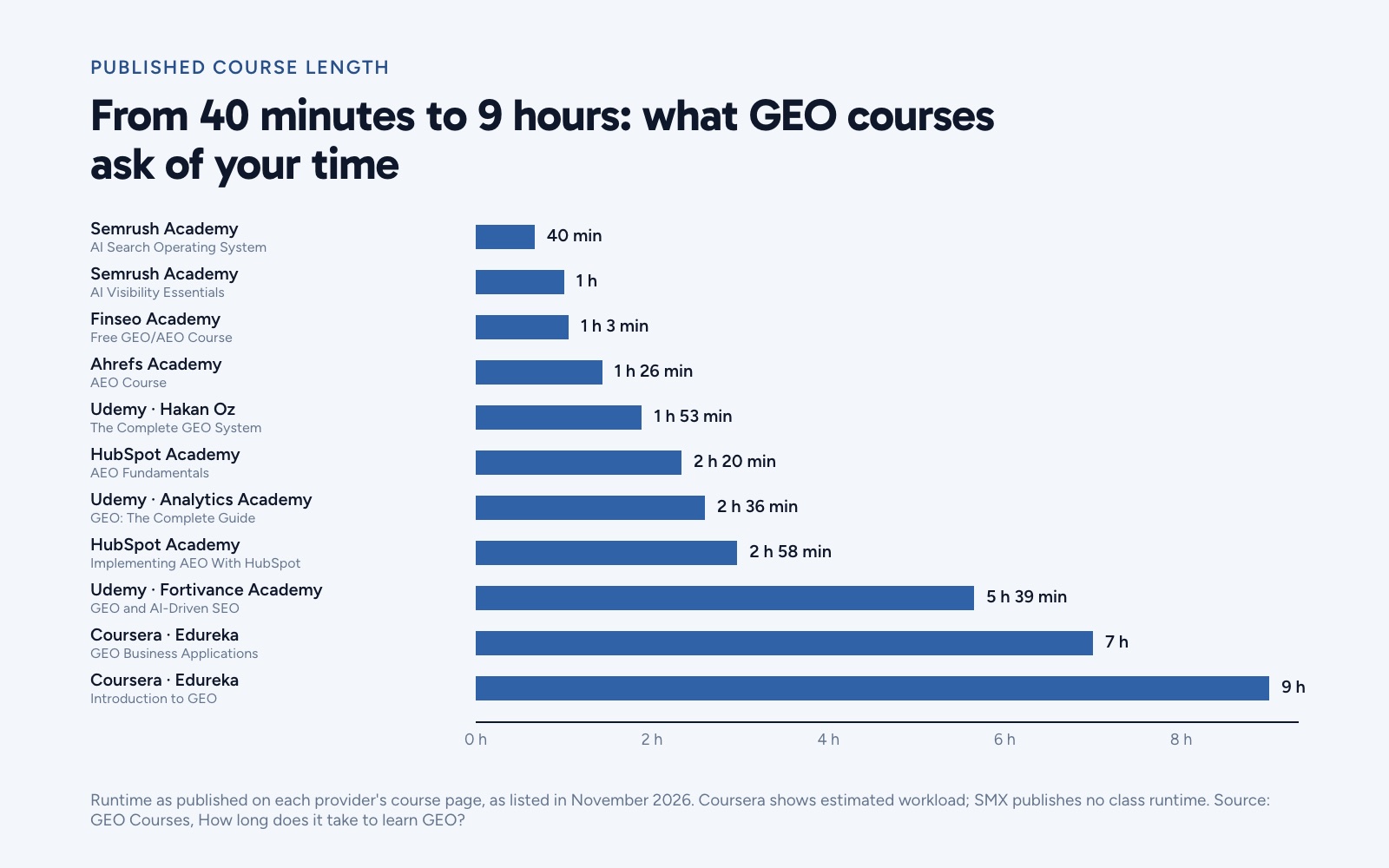
The clearest introductory course subtotal is approximately 2 hours 29 minutes: Finseo’s course is approximately 63 minutes and Ahrefs’ AEO course is 1 hour 26 minutes.[5][6] That is a viewing budget, not a demonstrated proficiency threshold.
| Course | Provider | Published length | Lessons/modules | Format |
|---|---|---|---|---|
| Free GEO/AEO Course & Certificate | Finseo | Approximately 63 minutes | 30 lessons; 8 modules | Short video lessons and certificate[5] |
| Answer Engine Optimization Course | Ahrefs | 1 hour 26 minutes | 12 lessons; 5 modules | Free online course[7] |
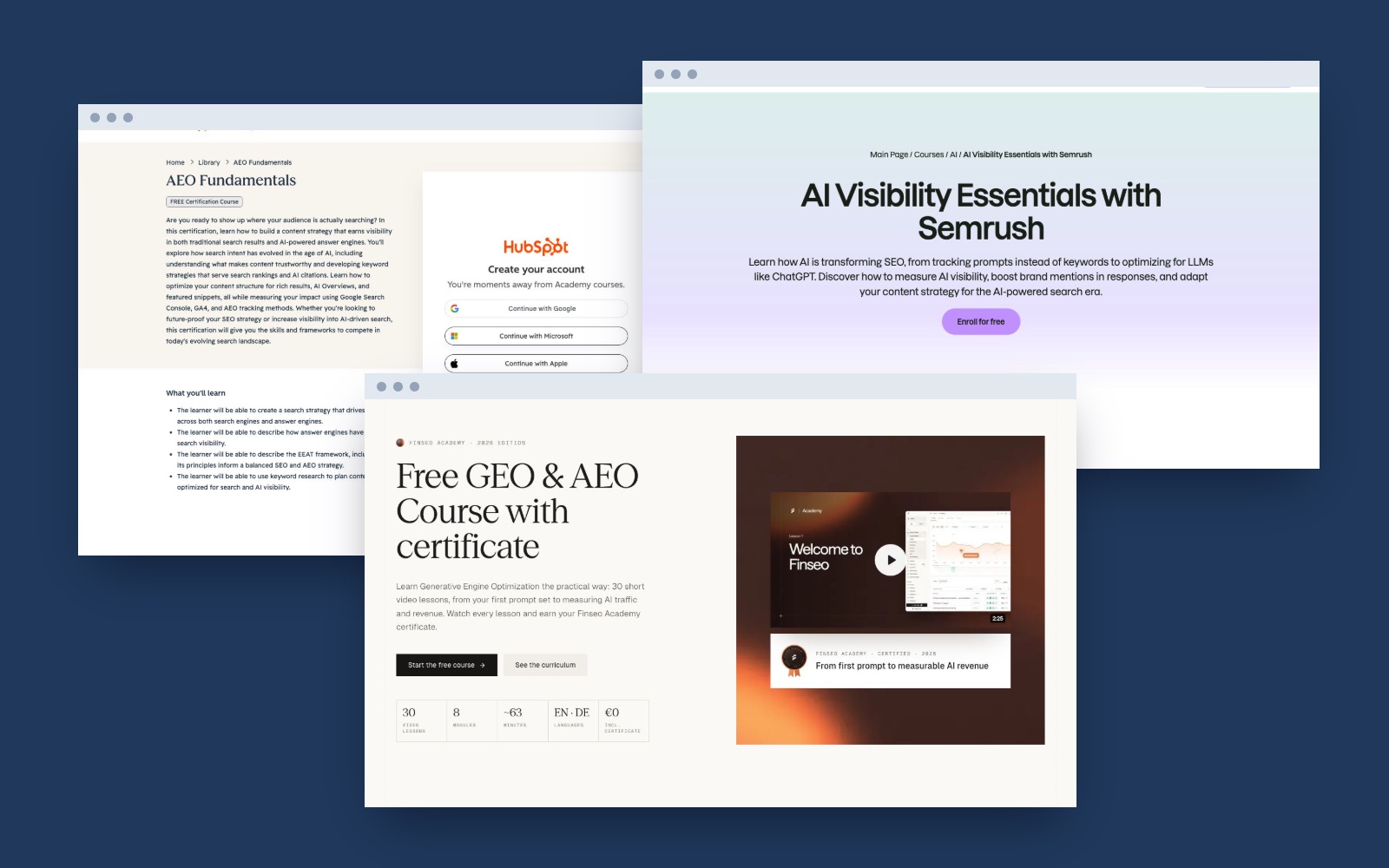
| AEO Fundamentals | HubSpot Academy | 2 hours 20 minutes | 7 lessons; 19 videos | Free certification course[8] |
| Implementing AEO With HubSpot | HubSpot Academy | 2 hours 58 minutes | 7 lessons; 23 videos | Free implementation certification[2] |
| AI Search Operating System | Semrush Academy | 40 minutes | 9 lessons; 9 videos | Free course[9][10] |
| AI Visibility Essentials with Semrush | Semrush Academy | 1 hour | 20 catalog entries | Free course; catalog duration[11][9] |
| On-Page SEO and AI Search Essentials with Semrush | Semrush Academy | 1 hour | 23 catalog entries | Free course; catalog duration[11][9] |
| Off-Page SEO and AI Search Essentials with Semrush | Semrush Academy | 1 hour | 18 catalog entries | Free course; catalog duration[12][13] |
| Introduction to GEO | Edureka on Coursera | 9 hours | 5 modules; 17 assignments | Self-paced course with estimated workload[14] |
| GEO Business Applications | Edureka on Coursera | 7 hours | 4 modules; 14 assignments | Self-paced course with estimated workload[15] |
| GEO: The Complete Guide | Analytics Academy on Udemy | 2 hours 36 minutes | 19 sections; 19 lectures | Video course[2][16] |
| GEO and AI-Driven SEO | Fortivance Academy on Udemy | 5 hours 39 minutes | 23 sections; 45 lectures | Video course[17][7] |
| The Complete GEO System | Hakan Oz on Udemy | 1 hour 53 minutes | 11 sections; 25 lectures | Video course[18] |
| GEO Master Class | SMX | Under 5 hours at series level | Not published for the class | Scheduled workshop and replay format[19] |
Which course length is most useful for planning?
Course runtimes measure different things. Coursera publishes estimated completion workloads, while Udemy calculates course length from lecture running time and excludes quizzes, practice tests, and coding exercises.[18] SMX’s “under 5 hours” applies to its series-level catalog, whereas the specific GEO class lists an agenda from 11:00 a.m. to 4:45 p.m. Eastern Time with breaks.
Semrush’s rounded catalog labels should also remain labels rather than being treated as stopwatch-precise runtimes. Its technical SEO course and AI Visibility Toolkit list individual video durations but do not publish a single aggregate duration on the course page.[4]
Finseo’s page says most learners finish with short sessions and describes lessons as two to three minutes long.[5] For teams that move from the course to Finseo’s platform, its enterprise page lists hosting in Frankfurt, Germany with EU data residency, GDPR compliance with a data processing agreement, and ISO 27001 certification. It also lists SAML single sign-on, roles per project, an audit trail and unlimited seats. The GEO course and certificate consists of 30 short video lessons and is included in every Finseo plan.[20]
HubSpot’s current courses should not be confused with its retired Answer Engine Optimization listing. AEO Fundamentals and Implementing AEO With HubSpot are separate current courses with different purposes and runtimes.[4]
What does a short GEO course actually teach?
A short course can establish the core concepts quickly:
- Learn the difference between traditional search visibility and visibility in generated answers.
- Understand mentions, citations, sources, prompts, and answer variability.
- Review practical content and measurement workflows.
- Complete the provider’s lessons or assessment.
- Apply the concepts to one site and one controlled prompt set.
The missing element is longitudinal evidence. Ahrefs recommends daily tracking for important prompts for at least a week to establish a baseline.[21][4] HubSpot gives a more conservative operating recommendation: collect daily, interpret weekly, and establish a four-to-six-week baseline before making intentional changes.[4]
What should you read alongside a GEO course?
The original GEO paper is a 12-page published proceedings paper, with Princeton recording the proceedings pages as 5–16.[22] Its official reading time is not published, so it should be scheduled as a reading assignment rather than added to a fabricated course-hour total.
The core reading list should include:
- GEO: Generative Engine Optimization: Read the definition, methods, evaluation metrics, results, and limitations.[1]
- Google Search Central’s AI features documentation: Review indexing eligibility, existing SEO requirements, content controls, and Search Console reporting.[23]
- OpenAI’s web-search documentation: Review query rewriting, sources, citations, and website inclusion.[24]
- OpenAI’s crawler documentation: Distinguish OAI-SearchBot, GPTBot, and ChatGPT-User, because they have different purposes and controls.[25]
- OpenAI’s publisher FAQ: Review search inclusion, robots.txt, and referral attribution.[26]
Google states that existing SEO practices remain relevant for AI Overviews and AI Mode, and that no special AI file, special markup, or special Schema.org structured data is required.[23] Google also reports AI-feature traffic within Search Console’s Web performance reporting.[27]
OpenAI separates OAI-SearchBot, which is used for ChatGPT search, from GPTBot, which is associated with model training.[25] Its publisher guidance also says ChatGPT referral links automatically include utm_source=chatgpt.com.[26]
The GEO paper reports 30–40% improvements in its position-adjusted visibility metric for certain techniques in its experimental setting.[1] That result should be read as a research finding under defined test conditions, not as a promise that a business page will gain visibility within a particular number of days.
Why does GEO practice take weeks rather than hours?
Watching a course is a concentrated learning activity. Measuring GEO is a repeated-observation activity. The answer can change even when the page, prompt, and learner have not changed.
Why does answer variance mean practice takes weeks rather than hours?
Generative systems may retrieve different sources or produce different categorical answers at different times. One study found answer changes after five minutes and again after 24 hours, while other research found low consistency in repeated brand recommendations.[3] A single screenshot therefore cannot show whether a page is visible, whether a change caused an improvement, or whether the result was ordinary answer variance.
A practical exercise needs a stable prompt set, repeated collection, unchanged settings, a dated change log, and enough observations to compare periods. The number of prompts and hours needed to create that setup are not published as universal requirements.[4]
The most defensible practice loop is:
- Choose a stable core set of branded and unbranded prompts.
- Record engine, wording, country, audience settings, date, answer, mentions, and citations.
- Collect daily where possible and summarize results by week.
- Investigate unexpected changes by repeating the prompt.
- Change one relevant piece of content and log exactly what changed.
- Continue collecting after the change.
- Compare weekly aggregates rather than isolated answers.
- Report an inconclusive result when the evidence does not support a conclusion.
A study of web search in the generative-AI era found that source overlap and categorical-answer stability vary by system and task.[3] SparkToro’s research similarly found substantial inconsistency in repeated brand recommendations, although it was not a controlled multi-week content intervention.[4] Another observational study estimated that more runs may be needed for precise brand-named-rate estimates, but its sample-size figures are study-specific rather than universal requirements.[4] Finseo’s own analysis found that Google AI Mode and AI Overviews share only 13.7% of cited URLs on the same query, which is one reason to record the engine for every observation rather than treating Google’s AI surfaces as one.
The timing of crawling adds another boundary. Google says recrawling after a control change can take several days to several months.[23] OpenAI’s approximately 24-hour adjustment guidance concerns robots.txt settings, not a guarantee that edited content will influence generated answers within one day.[4]
The right conclusion is not that GEO always takes four weeks or three months. It is that meaningful interpretation requires a baseline, a logged intervention, repeated post-change observations, and enough time to distinguish noise from a pattern.
How should you choose a study plan?
Choose the plan according to the outcome you need:
- Choose the one-week plan to learn the vocabulary and start a baseline.
- Choose the one-month plan to combine foundational lessons with a repeatable tracking workflow.
- Choose the one-quarter plan to complete a baseline, one documented change, and a post-change observation cycle.
These plans use only published course lengths. Reading, note-taking, assessment time, implementation, and tracking are additional and remain unquantified.[23]
One-week GEO study plan
- Complete Finseo’s approximately 63-minute GEO/AEO course.[5]
- Complete Ahrefs’ 1-hour-26-minute AEO course.[28][6]
- Read the relevant sections of the GEO paper and Google and OpenAI documentation; official reading times are not published.[4]
- Create one stable prompt set and record the engine, wording, location, date, answer, and cited sources.
- Begin daily collection for at least one week, treating the result as an initial baseline rather than evidence of a successful content change.[4][29]
One-month GEO study plan
- In week one, complete Finseo’s approximately 63-minute course and begin daily prompt collection.[4]
- In week two, complete Ahrefs’ 1-hour-26-minute course and refine the observation template.[4][21]
- In week three, complete HubSpot AEO Fundamentals in its published 2 hours 20 minutes.[4]
- In week four, complete Semrush’s 40-minute AI Search Operating System course.[10]
- Keep the core prompts and settings stable while reviewing results by week rather than reacting to one answer.[4]
- End the month with a baseline report, source list, change log, and list of unresolved questions.
HubSpot recommends a four-to-six-week baseline, so a one-month plan may establish useful habits without completing the full conservative baseline window.[4]
One-quarter GEO study plan
- Use the one-month plan as the first four weeks, for approximately 5 hours 29 minutes of published course time.[4]
- During weeks five through eight, complete Coursera’s Introduction to GEO, which lists a 9-hour estimated workload and 17 assignments.[20][14]
- During weeks nine through twelve, complete Implementing AEO With HubSpot in its published 2 hours 58 minutes if HubSpot is relevant to the learner’s implementation environment.[2]
- Establish a four-to-six-week baseline before making the planned content change.[2]
- Log one content change without changing the prompt wording, engine, country, or other key settings at the same time.
- Continue daily collection and summarize observations by week.[4]
- Compare the pre-change period with at least four post-change weekly aggregates as a proposed measurement exercise, not a universal validated deadline.[4]
- Review citations, answer wording, referral evidence, and unanswered prompts before writing the conclusion.
The four-to-six-week baseline plus four post-change weekly aggregates occupies roughly eight to ten weeks by calendar arithmetic. That fits within a quarter, but it does not prove that GEO gains appear within twelve weeks.
What should you do after finishing a course?
Do not stop at the certificate. Produce a small evidence package:
- A stable prompt set.
- A dated baseline.
- A record of answer text and citations.
- A page or content-change log.
- Weekly summaries.
- A post-change comparison.
- A clear statement of what the evidence cannot establish.
A universal prompt-set size, practice-hour requirement, or time-to-competence threshold is not published by the cited providers. The research literature also does not establish a stable, cross-platform causal deadline for improved organic discoverability or downstream behavior.[30]
The practical answer to “how long does it take to learn AEO?” is therefore two-part: a few hours to understand the mechanics, and several weeks of repeated measurement to begin interpreting results responsibly.
Frequently asked questions
How long does it take to learn GEO?
A short introduction can take approximately 2 hours 29 minutes using Finseo’s approximately 63-minute course and Ahrefs’ 1-hour-26-minute course.[5][3] Working competence takes longer because it requires prompt design, repeated observations, documentation, and at least one controlled content change; no universal time-to-proficiency is published.[4][20]
How long does it take to learn AEO?
HubSpot’s current AEO Fundamentals course is published at 2 hours 20 minutes, while Implementing AEO With HubSpot is published at 2 hours 58 minutes.[2] Those are course workloads, not complete learning timelines, because measurement and implementation remain outside the advertised lesson time.
Can I learn generative engine optimization in one week?
One week is enough to complete a compact introductory course sequence and start a prompt-tracking baseline. Ahrefs recommends daily tracking for at least a week for important prompts, so the week can establish a measurement habit but cannot demonstrate that a content change caused a durable visibility improvement.[4][21]
What is the fastest way to learn GEO?
The fastest responsible route is to complete a short introductory course, read the relevant Google and OpenAI documentation, create a stable prompt set, and collect repeated observations.[29][4] Skipping the baseline may make the process faster, but it also makes later changes difficult to interpret because generated answers can vary substantially.[4]
How many hours of practice are needed to learn GEO?
The cited course providers do not publish a universal number of practice hours, and practice time is not included consistently in course runtimes.[4] A useful minimum exercise is one stable prompt set, daily collection, weekly review, one logged content change, and repeated post-change checks.[4]
When should I expect GEO results after changing content?
There is no universal published results deadline. Google says recrawling after a control change can take several days to several months, while research shows that generated answers can also vary within minutes or a day, so both discovery timing and answer variance must be considered.[3]
Is completing a GEO certificate proof that I know GEO?
A certificate can document course completion, but it does not prove that a page is visible, cited, or generating qualified traffic. The GEO research distinguishes visibility-related outcomes from broader economic outcomes, and course completion is not a measurement of either.[2]
Should I study GEO for one month or one quarter?
Choose one month if the goal is foundational knowledge and a repeatable tracking workflow; choose one quarter if the goal is to run a baseline, document one content change, and review post-change observations. The quarter plan contains approximately 17 hours 27 minutes of published course time, while the rest of the calendar is devoted to reading, implementation, and measurement.[31][4]
Sources
- GEO: Generative Engine Optimization · arxiv.org
- Implementing AEO With HubSpot · academy.hubspot.com
- Characterizing Web Search in the Age of Generative AI · aclanthology.org
- How often to run AEO prompt tracking: A cadence guide · blog.hubspot.com
- Free GEO/AEO Course & Certificate | Learn Generative Engine Optimization · finseo.ai
- Ahrefs Academy: Learn how to apply Ahrefs’ tools & data in your Digital Marketing · ahrefs.com
- GEO & AI training with Will Scott | SMX® Master Classes | Apr. 14 · searchengineland.com
- AEO Fundamentals · academy.hubspot.com
- Free Online Marketing Courses & Classes from Semrush Academy · semrush.com
- Free AI Search Operating System Course - Semrush Academy · semrush.com
- On-Page SEO Course: Master Optimization with Semrush Tools (SEO & AI) - Semrush Academy · semrush.com
- Off-Page SEO and AI Search Essentials with Semrush - Semrush Academy · semrush.com
- Free AI Search Courses & Certifications | Semrush Academy · semrush.com
- Introduction to Generative Engine Optimization (GEO) | Coursera · coursera.org
- Generative Engine Optimization (GEO) Business Applications | Coursera · coursera.org
- Generative Engine Optimization (GEO): The Complete Guide · udemy.com
- Will Scott Returns to SMX Online With Generative Engine Optimization Master Class · searchinfluence.com
- Calculating Course Length – Udemy · support.udemy.com
- Search Marketing Workshops from SMX | Available On-Demand · searchengineland.com
- AI Answer Variance Study v2: 28,752 Answers, Five Engines · ewrdigital.com
- AI Visibility Data Paralysis: How to Get Unstuck · ahrefs.com
- GEO: Generative Engine Optimization - Princeton University · collaborate.princeton.edu
- AI Features and Your Website | Google Search Central | Documentation | Google for Developers · developers.google.com
- Searching the web with ChatGPT | OpenAI Help Center · help.openai.com
- Overview of OpenAI Crawlers · developers.openai.com
- Publishers and Developers - FAQ | OpenAI Help Center · help.openai.com
- Technical SEO and AI Search Essentials with Semrush: Master Site Optimization for Search Engines and AI - Semrush Academy · semrush.com
- Answer Engine Optimization (AEO) Course · ahrefs.com
- Prompt tracking methodology to measure AI visibility · semrush.com
- [2607.14035] Optimizing Visibility in Generative Engines: A Critical Survey of Generative Engine Optimization (2023-2026) · arxiv.org
- NEW Research: AIs are highly inconsistent when recommending brands or products; marketers should take care when tracking AI visibility - SparkToro · sparktoro.com