Jump to section
- Why do GEO skills matter for AI search visibility in 2026?
- The GEO skills roadmap at a glance
- 1. Build a strong SEO and web foundation
- 2. Master content research and answer design
- 3. How do AI assistants like ChatGPT retrieve and cite websites?
- 4. How do you track brand mentions, citations, and competitors in AI answers?
- 5. How do you connect AI visibility reporting to business outcomes?
- Which GEO career path should you choose?
- How should you learn GEO efficiently?
- What should GEO specialists avoid claiming?
- FAQ
- Sources
Summarize with ChatGPT Claude Perplexity
TL;DR
- A GEO specialist needs a hybrid stack covering technical SEO, editorial content, AI retrieval, measurement, analytics, and communication.[4]
- SEO remains the foundation because Google’s generative search features depend on crawlability, indexation, Search eligibility, and useful content.[1][5]
- The most valuable portfolio projects are a technical audit, an answer-focused content improvement, and a repeated AI-visibility benchmark.
- Learn crawler literacy by distinguishing search-discovery controls from model-training controls, such as the separate purposes documented for OAI-SearchBot and GPTBot.[4]
- Treat visibility as an observed signal rather than guaranteed business impact, and measure traffic, conversions, pipeline, and trust separately.[4][9]
Why do GEO skills matter for AI search visibility in 2026?
A GEO specialist needs a hybrid skill set: technical SEO, content strategy, AI retrieval literacy, measurement, analytics, and business communication. Current job postings range from content-led AEO roles to technical enterprise GEO managers, but the common foundation is the ability to make information crawlable, useful, retrievable, citable, and measurable.[1]
GEO, or generative engine optimization, is the practice of improving how brands and their content appear in AI-generated answers. Unlike traditional SEO, the output is not limited to a list of blue links: an AI system may summarize several sources, cite selected pages, mention competitors, or answer without sending a click.
The field is still developing. A 2024 academic paper frames GEO as a black-box optimization problem focused on visibility in generative engines, while a 2026 survey finds that research has concentrated more heavily on context allocation and citation than on crawling, organic retrieval, or user behavior.[2] That uncertainty makes disciplined fundamentals more valuable than promises of a single ranking trick.
What does a GEO specialist actually do?
A GEO specialist typically:
- Audits crawlability, indexability, rendering, structured data, and site architecture.[3][4]
- Researches the questions and topics that buyers may ask search engines and AI assistants.[4]
- Creates or improves answer-first content with clear entities, evidence, and useful context.[4]
- Studies how AI systems retrieve information, use citations, and expose crawler controls.[4][3]
- Measures mentions, citations, visibility, sentiment, traffic, conversions, and pipeline.[3][4]
- Communicates priorities to writers, marketers, engineers, product teams, and executives.[4]
The role is therefore closer to a cross-functional search strategist than to someone who only edits prompts or adds schema markup.
The GEO skills roadmap at a glance
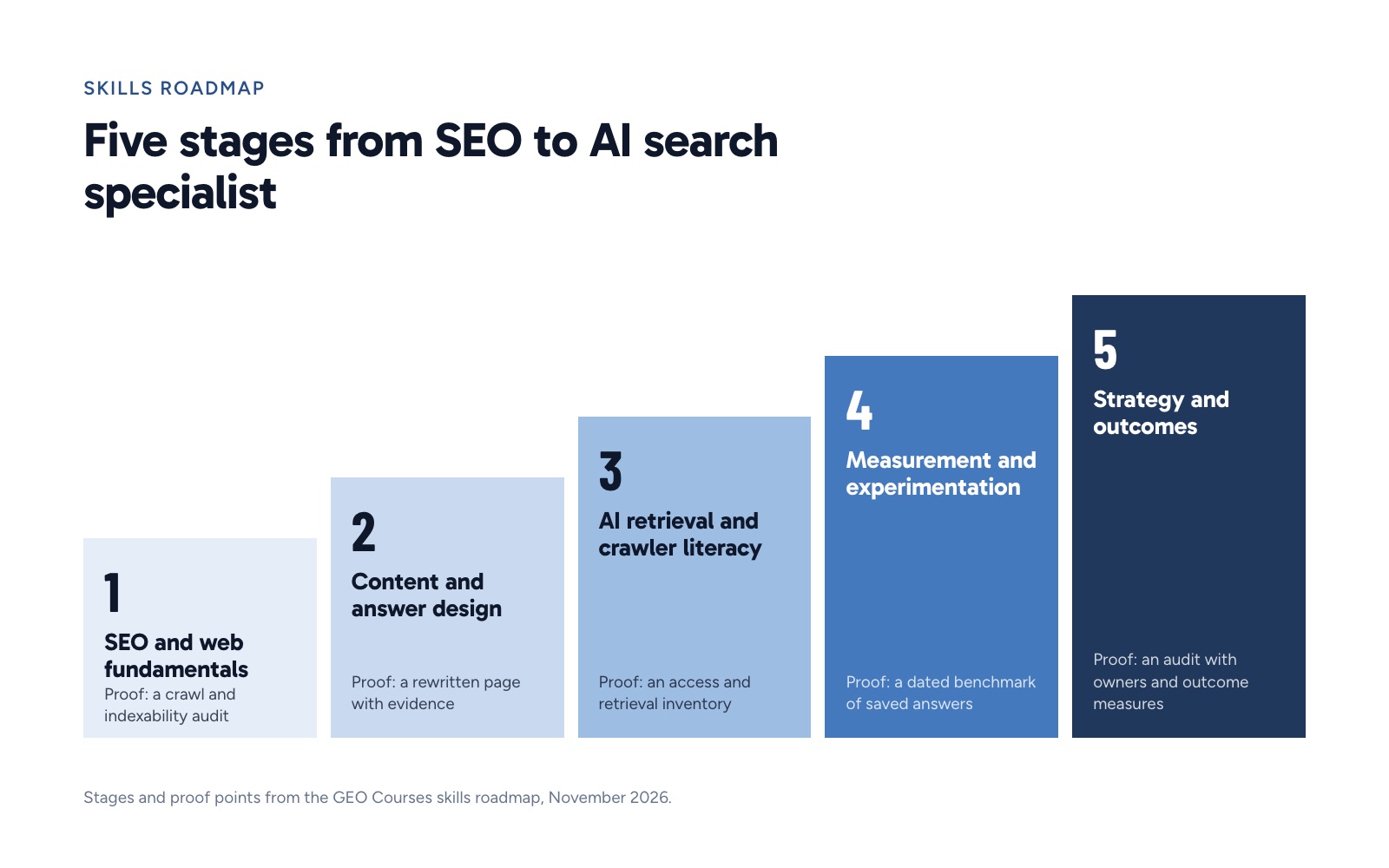
The roadmap below moves from durable foundations to specialist capabilities. Each stage should produce evidence of practical ability rather than only course completion.
| Stage | Core skills | Practical proof |
|---|---|---|
| 1. SEO and web fundamentals | Search intent, crawling, indexing, rendering, HTML, HTTP, robots.txt, sitemaps, internal links, Search Console | A documented crawl and indexability audit |
| 2. Content and answer design | Research, information architecture, entity clarity, writing, editing, storytelling, answer-first structure | A rewritten page supported by evidence |
| 3. AI retrieval and crawler literacy | Retrieval, grounding, chunking, citations, crawler purposes, platform controls | A platform-specific access and retrieval inventory |
| 4. Measurement and experimentation | Prompt sets, repeat testing, visibility, citations, sentiment, traffic, conversions, pipeline | A dated benchmark with saved observations |
| 5. Strategy and outcomes | Prioritization, stakeholder communication, analytics, attribution, experimentation | An audit with owners, priorities, and outcome measures |
Google says generative AI search features build on its existing Search ranking and quality systems. Pages must be indexed, crawlable, and eligible for a Search snippet; Google also says there is no special schema.org markup required for generative AI search.[1]
That means schema literacy remains useful as part of technical SEO, but adding a supposed “GEO schema” should not be presented as a guaranteed visibility tactic.[1]
1. Build a strong SEO and web foundation
The first step in an AI search career is conventional SEO. A GEO specialist who cannot explain how a page is crawled, rendered, indexed, and linked will struggle to diagnose why an AI system cannot find or use that page. Rendering is a good example: Finseo’s own crawler audit reports that most AI crawlers never run JavaScript, and 8.9% of 20,293 audited pages on 524 sites returned nothing readable.
Learn:
- Search intent and query interpretation
- HTML headings, links, metadata, and canonicalization
- HTTP status codes and redirects
- JavaScript rendering
- Robots.txt and crawler access
- XML sitemaps
- Internal linking and site architecture
- Structured data and entity relationships
- Core Web Vitals and page experience
- Search Console and log analysis
These are not outdated skills. Intrepid Digital lists crawlability, indexability, retrievability, HTTP, rendering, robots.txt, sitemaps, and structured data for its GEO Manager role.[4] Palo Alto Networks similarly asks for crawlability, indexation, JavaScript rendering, Core Web Vitals, structured data, architecture, logs, and analytics.[3]
Your first portfolio project
Choose a real or public website and create a technical audit containing:
- The important page types and their intended search purpose.
- Crawlability problems, blocked resources, redirects, and status-code issues.
- Indexation observations from Search Console or available search results.
- Internal-linking and site-architecture weaknesses.
- A prioritized repair plan with expected business relevance.
Do not claim that a technical fix will automatically make a brand appear in AI answers. The defensible claim is that accessibility and content quality are prerequisites for many forms of search visibility.[1][5]
2. Master content research and answer design
The second stage is editorial. AI systems need understandable, relevant information, and employers are hiring for the ability to research, structure, write, and edit that information.
ADP’s AI Search Content Strategist and Writer role emphasizes content strategy, search intent, information architecture, information hierarchy, user experience, research, writing, editing, and storytelling.[6] Intrepid asks for answer-first, self-contained content, while Google recommends unique, useful, and expert-led content.[1]
A GEO content specialist should know how to:
- Turn broad topics into specific buyer questions.
- Map questions to the buying journey.
- Organize pages around entities and relationships.
- Answer the main question early.
- Define ambiguous terms precisely.
- Support important claims with evidence.
- Use examples, comparisons, and clear headings.
- Remove unsupported generalizations and filler.
- Match the content to the audience’s level of knowledge.
“Write for AI” should not mean producing unnatural prose or stuffing repeated phrases into a page. A better principle is to make the page independently useful to a human reader while making its facts and relationships easy to identify.
Your second portfolio project
Select one substantive page and produce:
- A question and intent brief.
- An entity and terminology map.
- A revised outline.
- A concise answer-first introduction.
- Evidence for major factual claims.
- A before-and-after explanation of structural changes.
- A short editorial QA checklist.
This exercise demonstrates research and judgment, not merely the ability to generate text.
3. How do AI assistants like ChatGPT retrieve and cite websites?
The third stage differentiates a general SEO professional from an AI search specialist. You do not need to build a large language model, but you do need to understand the basic path from a question to an answer.
Learn these concepts:
- Retrieval
- Retrieval-augmented generation
- Grounding
- Context windows
- Chunking
- Citations
- Entity resolution
- Source selection
- Query expansion and fan-out
- Search crawlers and training crawlers
Intrepid’s GEO Manager listing refers to retrieval, grounding, chunking, citation, and AI-search monitoring.[4] OpenAI distinguishes OAI-SearchBot, which is used to surface websites in ChatGPT search, from GPTBot, which may crawl content for possible model training.[7]
That distinction matters. A website’s search visibility controls and its model-training controls are not automatically the same thing.[1] A specialist should inspect each platform’s documentation instead of assuming that one robots.txt rule governs every AI product.
Your third portfolio project
Create a crawler and access inventory for a test domain:
- Which bots are documented?
- What purpose does each bot serve?
- What does robots.txt allow or disallow?
- Are important pages accessible without client-side rendering?
- Are there authentication, rate-limit, or status-code barriers?
- Which controls relate to search discovery?
- Which controls relate to training use?
Describe what is known, what is uncertain, and which platform documentation supports each conclusion. This is more credible than claiming universal control over AI answers.
4. How do you track brand mentions, citations, and competitors in AI answers?
Visibility measurement is one of the most important GEO skills because AI answers vary. A 2026 study recommends repeated measurements and a distributional view rather than treating one answer as a stable ranking.[8][6] AMEC likewise recommends transparent testing across tools, prompts, markets, languages, and time, while separating visibility from outcomes.[9]
A useful measurement system records:
- Brand and domain
- Prompt wording
- Engine or platform
- Market and language
- Date and time
- Competitors observed
- Whether the brand was mentioned
- Whether the brand’s domain was cited
- Position or order of appearance
- Sentiment and factual accuracy
- Cited source quality
- Referral traffic
- Conversions and pipeline
A prompt set should represent real buyer questions rather than invented queries that merely contain a target keyword. Record the denominator: how many defined prompts were tested, how many produced valid observations, and how many were repeated.
Third-party visibility tools can help collect observations, but they do not provide access to Google’s internal ranking or AI systems.[1] Treat their outputs as measurement samples, not as ground truth.
Your fourth portfolio project
Build a dated benchmark with:
- Twenty to fifty buyer questions.
- At least two engines or search surfaces.
- A defined competitor set.
- Repeated observations for a sample of prompts.
- Mention and citation fields.
- A source-quality assessment.
- A traffic or conversion field where data exists.
- A limitations section.
The report should clearly distinguish “the brand appeared in observed answers” from “the work generated revenue.” AMEC’s principles specifically call for separating visibility from awareness, trust, behavior, and impact.[9]
5. How do you connect AI visibility reporting to business outcomes?
At entry level, a specialist may produce audits and content recommendations. At senior level, the job becomes prioritization: deciding which problem deserves attention, who owns it, and how success will be evaluated.
Palo Alto Networks connects GEO work with AI citations, traffic, pipeline, revenue, analytics, and communication across content, marketing, engineering, and IT.[3] Keysight asks for opportunity research, content roadmaps, citations, share of voice, traffic, conversions, dashboards, experimentation, and stakeholder communication.[10] RavenPack combines AEO with paid media, B2B lead generation, product-led growth, GA4, Search Console, and performance marketing.[11]
A senior GEO specialist should be able to:
- Rank opportunities by likely business value and effort.
- Explain technical problems to nontechnical stakeholders.
- Turn source and citation gaps into content or PR plans.
- Connect AI referral traffic with landing pages and conversions.
- Design experiments without overstating causality.
- Establish owners, deadlines, and review points.
- Report both progress and uncertainty.
Your fifth portfolio project
Prepare a short executive-ready audit:
- One-page summary.
- Three observed visibility opportunities.
- Evidence for each opportunity.
- Technical, content, or authority recommendation.
- Owner and estimated effort.
- Success metric.
- Review date.
- Risk or limitation.
This shows the difference between listing metrics and making useful decisions.
Which GEO career path should you choose?
The selected job postings suggest four practical profiles. They share the same foundation but emphasize different strengths.[1]
Content-led AEO or GEO specialist
Best suited to writers, editors, content strategists, and SEO professionals who enjoy research and information design.
Focus on:
- Search intent
- Content architecture
- Information hierarchy
- Expert writing
- Editorial standards
- Storytelling
- User experience
ADP’s role is a clear example of this profile.[6]
Technical enterprise SEO and GEO specialist
Best suited to technical SEOs, developers, analytics specialists, and enterprise marketers.
Focus on:
- Crawling and rendering
- Indexation
- Site architecture
- Logs
- Structured data
- Core Web Vitals
- Dashboards
- Traffic and conversion analysis
Palo Alto Networks and Keysight illustrate this path.[3]
End-to-end agency GEO consultant
Best suited to consultants who want to combine audits, content, authority, measurement, and client communication.
Focus on:
- Technical audits
- Prompt sampling
- Retrieval literacy
- Entity and third-party authority
- Content roadmaps
- Reporting
- Stakeholder management
Intrepid Digital’s GEO Manager role represents this broad profile.[4]
Performance-growth AEO specialist
Best suited to marketers who already work with paid media, lead generation, analytics, or product-led growth.
Focus on:
- AEO and SEO
- Paid and organic channel integration
- B2B demand generation
- Product marketing
- GA4
- Search Console
- Conversion measurement
RavenPack’s listing combines these requirements.
How should you learn GEO efficiently?
A practical learning sequence is:
- Learn technical SEO and inspect real websites.
- Study search intent, content architecture, and editorial quality.
- Read platform documentation for crawlers and AI search surfaces.
- Build a small prompt set from real customer questions.
- Record repeated observations instead of relying on one answer.
- Connect visibility observations to traffic and conversion data.
- Publish two or three documented portfolio projects.
- Specialize in content, technical enterprise work, agency consulting, or performance growth.
- Practice presenting findings to nontechnical stakeholders.
- Revisit your measurement framework as platforms and interfaces change.
Use official documentation for platform behavior, employer postings for skill-market signals, and academic research for methodological boundaries. Job advertisements show what particular employers request; they do not prove that every listed tactic is effective in every AI system.
What should a beginner include in a GEO portfolio?
A beginner can build a technical crawl audit, an answer-first content rewrite, and a small repeated-visibility benchmark. Each project should show the starting evidence, the method, the changes made, and the limitations. A documented process is more persuasive than an unsupported claim that a page “ranked in AI.”
What should GEO specialists avoid claiming?
Avoid promising a fixed position in AI answers, guaranteed citations, or automatic revenue growth. AI outputs vary across prompts, runs, platforms, and time, and current research supports repeated measurement rather than one-time certainty.[8]
Avoid treating special markup as a universal Google requirement. Google says there is no special schema.org markup required for generative AI search, even though structured-data knowledge remains useful within broader technical SEO.[1]
Avoid collapsing all AI crawlers into one category. OpenAI documents different purposes for OAI-SearchBot and GPTBot, so search discovery and training controls should be discussed separately.[7]
Finally, avoid presenting visibility as business impact. A mention or citation is an observation; traffic, trust, leads, and revenue require separate measurement and attribution.[10]
Frequently asked questions
What skills does a GEO specialist need?
A GEO specialist needs technical SEO, content research, answer design, AI retrieval and crawler literacy, measurement, analytics, and stakeholder communication. The strongest roles combine these capabilities rather than focusing on a single prompt or markup technique.[1]
Is SEO experience necessary for an AI search specialist?
SEO is the most practical foundation because Google says its generative AI search features build on existing Search systems and require pages to be indexed, crawlable, and eligible for snippets.[1] SEO experience also helps specialists understand search intent, site architecture, technical access, and content quality.
Do I need to learn coding to work in GEO?
You do not need to become a software engineer, but you should understand HTML, HTTP, rendering, robots.txt, sitemaps, structured data, and basic logs. Technical GEO roles explicitly request these skills, especially when specialists must diagnose crawlability and indexation problems.[3]
Is there special schema markup for GEO?
Google says there is no special schema.org markup required for generative AI search.[1] Learn structured data as part of technical SEO and entity clarity, but do not present it as a guaranteed way to obtain AI citations.
How do GEO specialists measure AI visibility?
They define a repeatable prompt set and record the engine, prompt, market, language, date, brand mentions, citations, competitors, sentiment, and source quality. Repeated observations are important because AI outputs vary across runs and over time.[8]
Can GEO guarantee traffic or revenue?
No. A brand mention or citation measures observed visibility, not business impact. Traffic, conversions, pipeline, revenue, awareness, and trust require separate outcome measures and transparent attribution.[3]
Can AI visibility tools show how Google's AI systems rank a brand?
Third party visibility tools can help collect observations, but they do not provide access to Google's internal ranking or AI systems.[1] Treat their outputs as measurement samples, not as ground truth. Repeated measurements across tools, prompts, markets, languages, and time give a more reliable view than any single answer.[8][9]
What should an AI visibility report include for competitors and share of voice?
A useful report records the prompt, engine, market, language, date, competitors observed, brand mentions, domain citations, position, sentiment, and cited source quality. Enterprise roles such as Keysight's also ask for share of voice, traffic, conversions, and dashboards.[10] AMEC recommends keeping visibility metrics separate from outcomes such as trust, behavior, and impact.[9]
Are ChatGPT search visibility and AI training crawlers controlled the same way?
No. OpenAI distinguishes OAI-SearchBot, which is used to surface websites in ChatGPT search, from GPTBot, which may crawl content for possible model training.[7] Search visibility controls and model training controls are not automatically the same, so check each platform's documentation instead of relying on one robots.txt rule.[1]
Sources
- Google's Guide to Optimizing for Generative AI Features on Google Search | Google Search Central | Documentation | Google for Developers · developers.google.com
- Optimizing Visibility in Generative Engines: A Critical Survey of Generative Engine Optimization (2023–2026) · arxiv.org
- Generative Engine Optimization (GEO) Manager at Palo Alto Networks · jobs.paloaltonetworks.com
- GEO Manager (Generative Engine Optimization) | Intrepid Digital · gointrepid.com
- Google Search's Guidance on Generative AI Content on Your Website | Google Search Central | Documentation | Google for Developers · developers.google.com
- AI Search Content Strategist & Writer (AEO/GEO), Roseland, New Jersey, United States, Roseland NJ (1 ADP Blvd. - 40014), 07068 | ADP Careers · jobs.adp.com
- Overview of OpenAI Crawlers · developers.openai.com
- [2604.07585] Don't Measure Once: Measuring Visibility in AI Search (GEO) · arxiv.org
- The AMEC GEO Principles · amecorg.com
- SEO & GEO Specialist in Multiple Locations | Keysight Technologies, Inc. · jobs.keysight.com
- Senior Performance Marketing & AEO Specialist - RavenPack · ravenpack.teamtailor.com